Every pool-cost answer online is a range wide enough to be useless. Here are the real 2026 Tampa numbers — where custom gunite pools start, where most finished projects land, what actually moves the price, and how to get an exact figure for your own yard.
Search “how much does a pool cost in Tampa” and you get the same non-answer a hundred ways: “it depends,” a national average built from Midwest vinyl liners, or a range so wide it covers everything from a splash pad to a resort. The vagueness is not an accident. Most of those pages exist to capture your email, and most builders do not want to be held to a number before they have walked your lot. We publish our numbers. Here is what a pool actually costs in Tampa Bay in 2026, what moves the price, and how to trade the range for an exact figure.
The honest 2026 Tampa numbers
Custom gunite pools in Tampa start around $55,000. Most complete custom pool projects land between $70,000 and $150,000-plus, depending on size, finishes, features, decking, and enclosures. Those are the numbers we quote against every week across Pinellas and Hillsborough, and they will not match the $35,000–$45,000 figures on national sites — those are typically small fiberglass or vinyl-liner installs, or a gunite “starting price” with the deck, the safety barrier, and half the equipment quietly excluded. A real custom gunite pool is a steel-reinforced structure engineered to your specific lot, and in this market it does not start with a 3 or a 4.
One clarification before the breakdown: this guide covers building a new pool. If you already own one and the number you actually need is a remodel, pool interior resurfacing starts around $8,000–$12,000 — the full picture is on our remodels page.
Rule of thumb for Tampa: the pool itself is usually only half to two-thirds of the finished project. Whatever base pool price you are quoted, hold back budget for decking, the code-required safety barrier, and features before you fall in love with a design.
What actually moves the price
Two Tampa homeowners can order the “same” 15-by-30 pool and end up $40,000 apart — and neither of them got ripped off. The total is set by seven levers, and every one of them is a genuine choice:
- Size, shape, and depth — more square footage means more excavation, steel, gunite, and interior finish, and complex geometry costs more to form than a clean rectangle.
- Interior finish — plaster is the entry point; PebbleTec lasts far longer and holds its color in Florida sun. It is LIV’s standard spec, not an upgrade.
- Features — an integrated gunite spa typically adds $15,000–$25,000, and sun shelves, water features, and fire bowls each add real line items.
- Equipment and automation — pump, salt system, heater, and app-based controls. A variable-speed Hayward pump and salt system are standard on every LIV build.
- Decking — the material (brushed concrete vs. pavers vs. travertine) and, just as much, the square footage you wrap around the water.
- Screen enclosure — typically $15,000–$40,000+ in Tampa depending on size and style, and it doubles as your code-required safety barrier.
- Site conditions — equipment access, soil, the water table, and your lot’s drainage and coverage rules.
Site conditions are the lever nobody budgets for, because they are invisible until the survey. Tampa Bay’s water table is high — on some lots the dig needs dewatering before the shell can be formed. Tight Pinellas infill lots can restrict equipment access, which slows excavation and raises cost. And a pool deck adds impervious surface that can push a lot past City of Tampa coverage limits, triggering drainage and retention work — the constraints are covered in our guide to permitting a pool in Tampa. None of this is exotic. It just has to be priced from your actual lot, not a template.
Where the money is best spent is the interior and the equipment pad, because those are the parts you live with daily and replace rarely. Every LIV pool comes standard with a PebbleTec interior, a variable-speed Hayward pump, and a salt system — the spec most builders sell as an upgrade package. As an Authorized Hayward Dealer we install and warranty the equipment we spec, and the most common additions from there are heat and full automation: a heater typically adds a few thousand dollars and is what turns a Tampa pool into a twelve-month pool. You can compare interior options side by side on our finishes page.
What each budget actually buys in Tampa
- $55,000–$70,000 — a genuine custom gunite pool, honestly specced: a modest footprint in a clean shape, PebbleTec interior, variable-speed pump and salt system, LED lighting, a right-sized paver deck, and a lifetime structural warranty on the shell. No spa, no enclosure — restraint on square footage, not on quality.
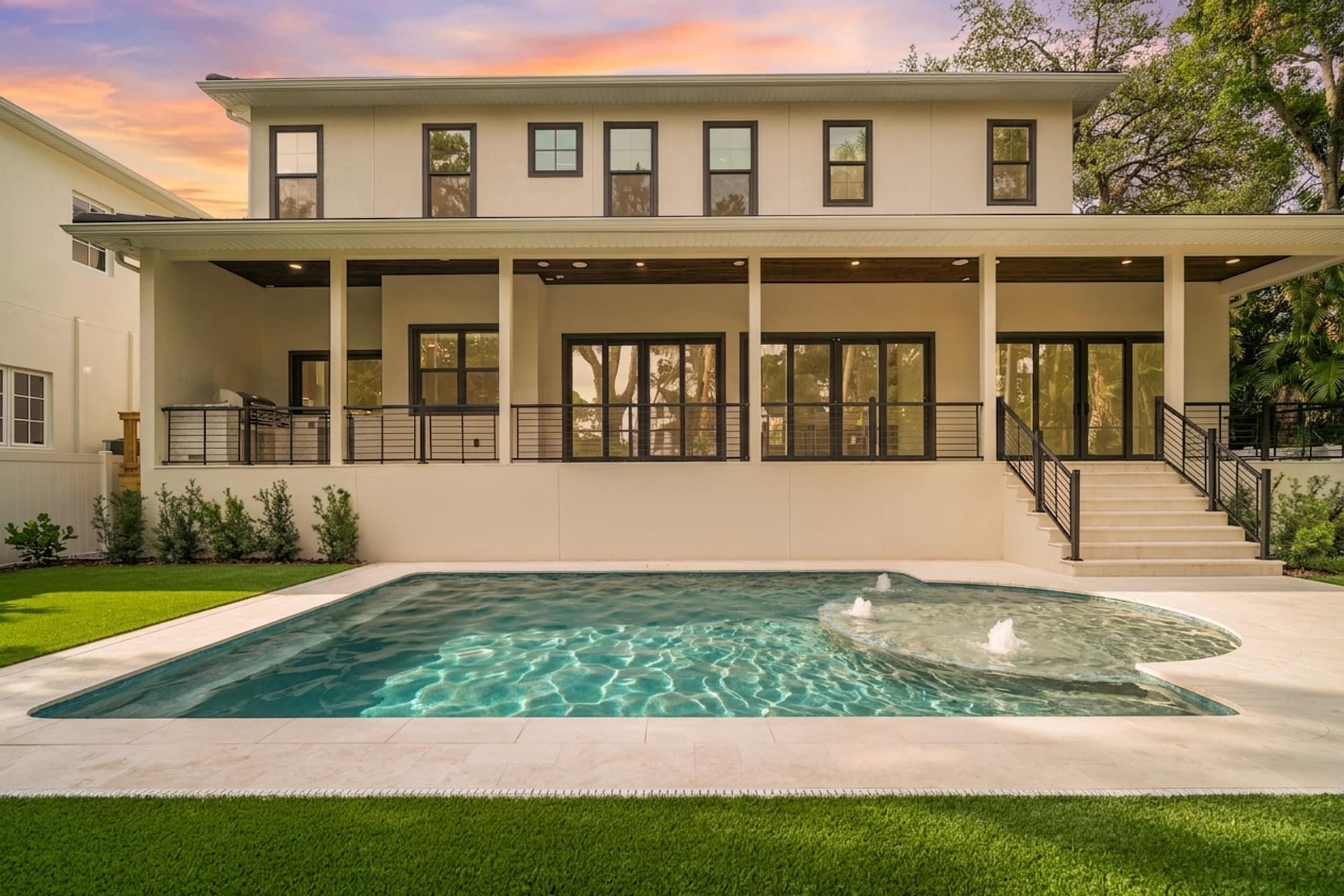
- $70,000–$100,000 — where most complete projects land: a larger pool, a sun shelf with bubblers or a water feature, a heater, expanded decking, and app-based automation. At the top of this range, an integrated spa comes into play.
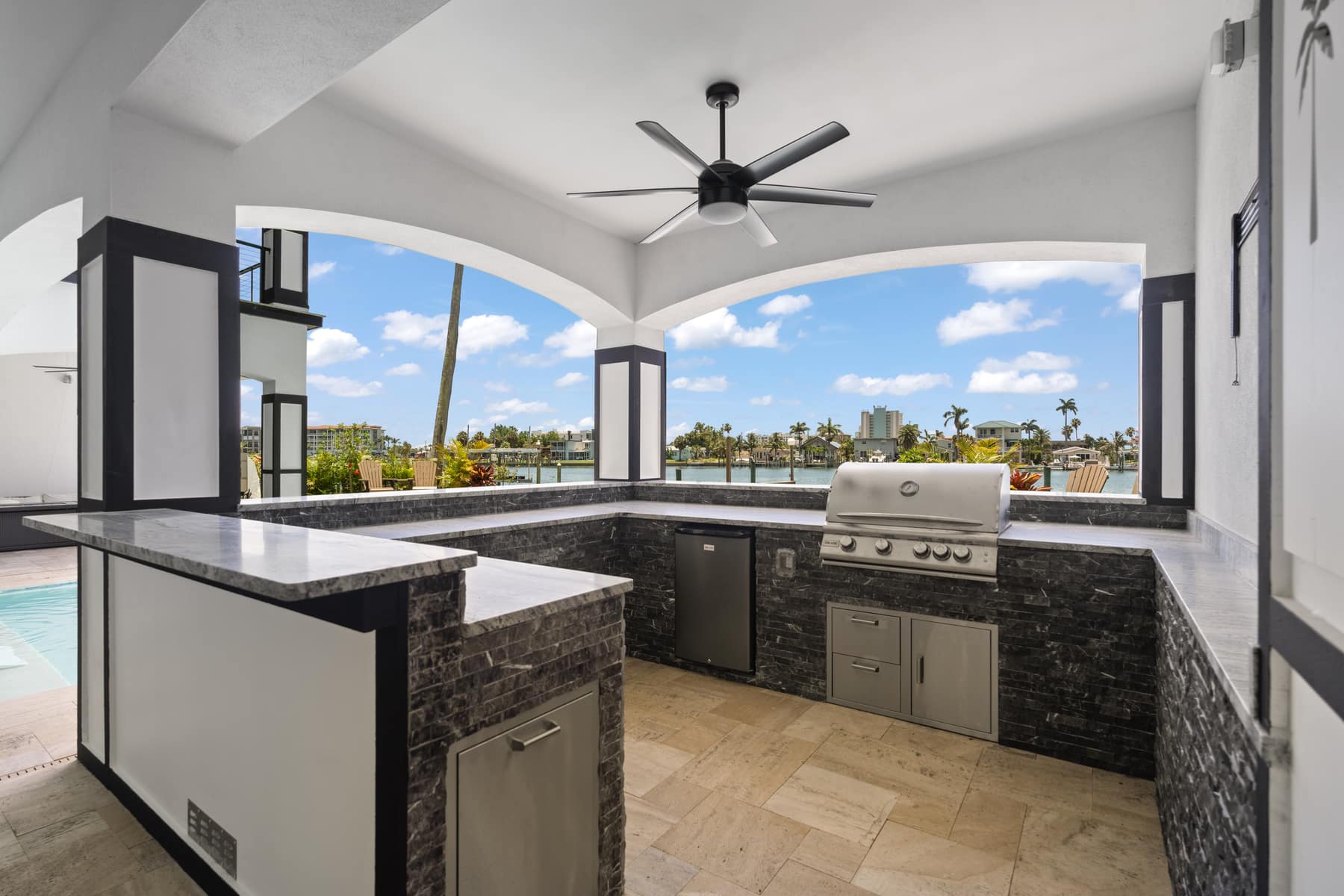
- $100,000–$150,000+ — the full outdoor room: pool plus raised spillover spa, travertine decking, fire and water features, a panoramic screen enclosure, and the lighting and landscape to tie it together. Larger lots and complex sites live here too.
The costs people forget to budget
Some of the classic “hidden costs” are not hidden at LIV — permitting and engineering are handled in-house and included in the quote, so there is no surprise invoice for plans, submittals, or revisions. But a few real costs sit outside almost any pool contract, and Florida law makes the first one mandatory:
- The safety barrier — Florida’s Residential Swimming Pool Safety Act requires a fence, screen enclosure, or other approved barrier before final inspection. A screen enclosure typically runs $15,000–$40,000+; an aluminum fence for a typical yard is usually a few thousand dollars.
- Landscaping repair — excavation equipment has to cross your yard to reach the dig. Budget to restore sod, irrigation lines, and plantings after the build.
- Utility runs — a gas heater needs a gas line, and older homes sometimes need panel capacity for the equipment pad. Because LIV holds electrical and gas licenses in-house, these show up as priced lines in the quote instead of mid-build discoveries.
- Ownership costs — electricity, chemicals, and upkeep are a modest monthly line, and the variable-speed pump and salt system we include as standard keep both sides of that math lower.
Why two quotes for the “same pool” can be $30,000 apart
Because they are not the same pool. The spread between builders almost never comes from margin — it comes from spec games: a single-speed pump where you assumed variable-speed, plaster where you pictured PebbleTec, a deck allowance that covers half the square footage drawn in the rendering, “permits by owner” buried in the exclusions, and no safety barrier at all. The low bid finds its margin later, in change orders. It is why every LIV quote is itemized and transparent — every line has a scope and a price, so you can set it next to any other bid and compare apples to apples. Our buyer’s guide walks through exactly what to check, line by line, before you sign anything.
Any builder can hand you a low number. An itemized quote is the only version of the truth — every line either has a price on it now, or it becomes a change order later. We would rather lose a bid on paper than win it in change orders.
The financing reality
Most Tampa pool buyers do not write a check for the whole number — they finance some or all of it through pool-specific lenders, a HELOC, or a cash-out refinance. As a reference point, LIV projects can be financed from about $366 a month, depending on the amount, the term, and your credit profile. The useful move is to run the monthly math early: a $75,000 project at a comfortable monthly payment is a very different decision than a $75,000 lump sum, and knowing your monthly number tells you your real budget tier before design starts, not after. Current options are on our financing page.
How to get an exact number for your yard
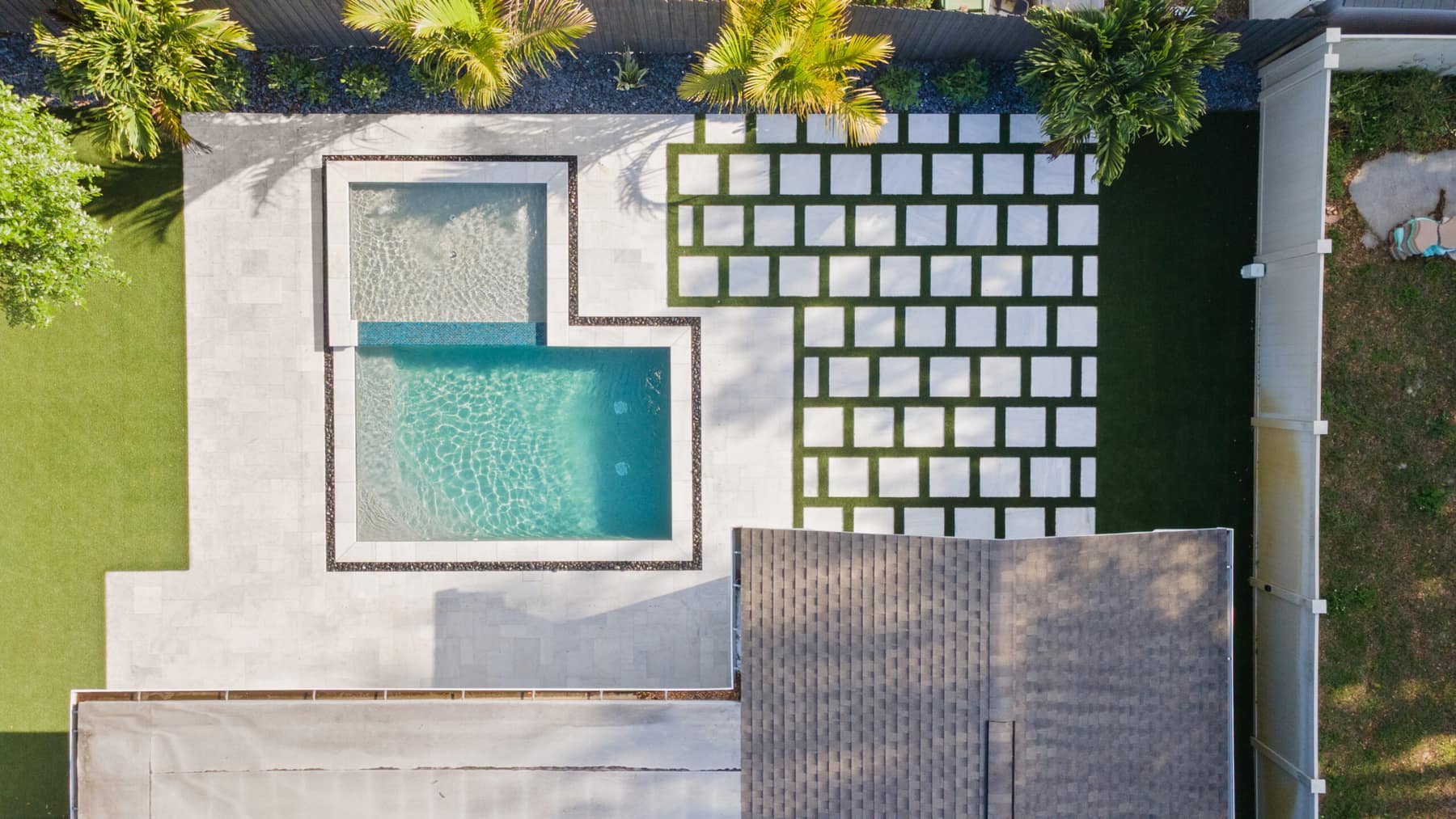
A range is where budgeting starts, but nobody builds a range. The only accurate price is one drawn from your lot — the survey, the setbacks, the access, the water table — and your actual selections. That is why LIV starts every project with a free 3D design and a transparent, itemized quote: you see your own backyard with the pool in it, and every line item that gets you there, before you commit a dollar. We build across Pinellas and Hillsborough (and the Pasco edges), with a showroom in Largo where you can put your hands on the finishes. When you are ready to swap the range for a real number, get in touch — the design costs nothing, and the quote holds nothing back.
Common questions.
Per-square-foot pricing is the least reliable way to budget a custom pool, but as a sanity check, finished custom gunite projects in Tampa typically work out to roughly $125–$250 per square foot of pool surface once decking, equipment, and features are included. The spread is wide because the deck, spa, and enclosure move the total far more than the water does. Budget from the $70,000–$150,000 project range instead.
Keep it small, simple, and honestly specced. A modest custom gunite pool in a clean shape with a restrained deck starts around $55,000 in Tampa. Shrinking the footprint and skipping the spa saves far more than downgrading equipment, which just costs you later in energy and repairs. Fiberglass and vinyl run less up front, but they trade away design freedom and long-term durability in Florida conditions.
In Tampa Bay you can swim most of the year, so the cost-per-use math works better here than almost anywhere in the country. A well-built inground pool is broadly treated as a selling feature in the Florida market rather than a liability. The honest framing: resale recovers part of the cost, but the real return is roughly ten swimmable months a year for as long as you own the home.
Most are national averages built to capture your contact info, and they miss the Tampa-specific costs: high-water-table dewatering, screen enclosures, impervious-coverage drainage rules, and Florida’s mandatory safety barrier. They also rarely say what is excluded. Treat a calculator’s number as a floor, not an estimate — the only accurate figure is an itemized quote drawn from your actual lot and survey.
Most buyers finance some or all of the project through pool-specific lenders, a HELOC, or a cash-out refinance. As a reference point, LIV projects can be financed from about $366 per month, depending on the amount financed, the term, and your credit profile. Run the monthly number early — it tells you your real budget tier before design starts, not after.